 Module 8, SLIS 5420
Summary
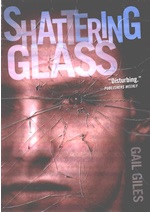
Simon Glass is a nerdy, overweight guy and is picked on by some of the elite students at school, especially former king of the hill Lance. Rob has replaced Lance at the top of the male pecking order and decides to use Simon as a tool to humiliate Lance. Rob, a mysterious and charasmatic transfer student, enlists his friends, including Young, the narrator, to turn Simon Glass into a popular guy. He succeeds in changing Glass into a new person, accepted by almost the entire school, but have Rob and the gang underestimated the apparently timid and pliable Glass? What are the consequences for everyone involved?
Bibliographic Information
Giles, Gail. Shattering Glass. Simon Pulse, 2002. ISBN: 0-7569-1480-9
My Thoughts
This is a very disturbing book. There are hints throughout it in the introductions to every chapter that something bad is going to happen. The consequences for those involved are hinted at, as are the identities of those who are held responsible for what happens, but the facts are played out in the order in which they occur and the reader is teased into following along to the end to find out what actually happens. This is a very effective tactic on the part of the author. All of the characters are depicted as having very human qualities. No one person is entirely good and no one person is entirely bad. Together, their qualities and frailties help to contribute to a plausible and unfortunate ending. The reader is left to think about how the best laid plans can get out of hand, how difficult it is to anticipate the results of one's actions, and how those actions can affect one (and others) for the rest of their lives.
ReviewsGr 9 Up-Gail Giles' debut young adult novel (Millbrook, 2002) makes a searing audio production as read by Scott Brick. His cold, calculating delivery style raises the tension on this already tense story about an in-group of high school seniors led by a true sociopath. Listeners can tell from an early scene involving torture of a laboratory animal that Rob means the most chilling sort of trouble for Simon Glass, class misfit. The story's narrator, Young Steward, a member of the clique, makes clear the grip Rob has on all his friends and focuses on his implacable intention to re-make Simon for purposes of his own. The violent frenzy Rob orchestrates ends in Simon's death after he shows signs of self-confidence that Rob can't allow. With a constant edge in his voice, Brick never lets up as he relates this riveting story. One somewhat problematic factor is the series of quotes from classmates and adults that introduce each chapter. As read, they are sometimes difficult to distinguish from the actual chapter narrative, leading to momentary confusion. The cover includes a list of chapters contained on each side of the tapes, a nice feature for finding a place in the text version. Reminiscent of Lord of the Flies, this is a story with mature themes focusing on the darkest side of human nature but in the most chillingly realistic of modern settings. The compelling writing is enhanced with convincing narration, but its intensity may give pause for thought.
Fenn, Jane P. School Library Journal. July 1, 2003.
By the end of the first paragraph, readers know that Simon Glass was easy to hate and that eventually he was killed. It takes the rest of the book to find out who killed him and why. Told in the different voices of students, teachers, counselors, and law-enforcement officers, the story unfolds little by little until the explosive climax. The reader soon realizes that the narrator of the story, Young, was one of Simon's classmates and is in prison for killing him, but it does not seem possible given the manner in which Young's character is portrayed. It soon becomes clear that Rob, Young's friend and unofficial group leader, is a master manipulator, pulling the strings of all the characters, influencing their actions to fulfill his master plan. In the early pages of the book, the language used by the students, the way they talk to and refer to each other might not seem authentic. After that initial reaction, though, as the suspense begins to build, readers will find it hard to put down the book. Robert Cormier's recent The Rag and Bone Shop (Delacorte Press, 2001/VOYA October 2001) explores the question of how a person can be influenced to do something that they ordinarily would not do. Although the plots of the two books are dissimilar, Giles's novel is also a chilling portrayal of manipulation leading to tragic consequences. Teens in upper middle school and high school will relate to the characters and, sadly, to some of the events in this book.
Roberts, Linda. Voice of Youth Advocates. June 1, 2002.
Awards
California Young Reader Medal
Suggestions for Use in Library
This would be a good candidate for helping students understand the dynamics of student popularity and the dangers of blindly following the advice or suggestions of fellow students. The story could be used to help students try to identify the motives of others and trace the consequences of not following one's own instincts.

No comments:
Post a Comment