Thursday, August 12, 2010

Amelia Rules! Superheroes

Module 10, SLIS 5420

Summary

Superheroes is the third installment in the Amelia Rules! series of graphic novels. In this one, Amelia and her friends come into conflict with the Park View Ninjas, a group of rival kids who dress and act like ninjas instead of superheroes, like Amelia's friends. Their contact comes about within the framework of Amelia's mother wanting to move into a house in Park View. The Ninjas manage to mislead the Superheroes into believing that there was a third group, the Legion of Steves, responsible for a great conspiracy throughout history. The Legion of Steves is supposed to be responsible for most of the ills that have beset humanity, and Reggie, leader of the Superheroes, vows to bring them down. The book is very funny and filled with action and humor as the various characters fantasize about how they would deal with their daily lives and their superhero identities, slipping between those fantasies and the real world. But all is not well in Amelia's world. She and the Superheroes, and their new friends the Ninjas, befriend a girl named Trish who writes for the neighborhood fan-zine Tweenie Zeenie. Amelia discovers that Trish has a congenital heart problem and is in a very fragile condition. She should not be participating as a new member of the Superheroes. This book takes a lighthearted look at the creative imaginations of tweens, poking fun at their vulnerabilities and passions, yet shows that sometimes the serious side of life intrudes, and that getting through these difficulties, through sharing experiences of all kinds, kids can help each other and make a difference in one anothers lives in meaningful ways.

Bibliographic Information

Gownley, Jimmy. Amelia Rules! Superheroes. Renaissance Press, 2006. ISBN: 0-9712169-7-5

My Thoughts

This is a good series to use in introducing tweens and reluctant readers to the graphic novel format. The characters are appealingly real. Readers will recognize people they know or have known in the characters. The art is well done and fits seamlessly with the text. The expressions and the body language of the characters helps the reader understand the emotions of the characters. The character of PajamaMan is especially amusing as his emotions and reactions can be read in the exclamation points and question marks that appear on his pajama tops. It is a book that is both fun and serious in a way that does not talk down or condescend to tweens. Fantasy sequences are tipped off with transitions that are dream-like, such as a switch to black and white, characters becoming insubstantial, or a lack of detailed background scenery.

Reviews

Gr. 4-7 In this third volume of the Amelia Rules! series, the school year has ended, but summer isn't carefree. Amelia must deal with the possiblity of moving out of the neighborhood; then her new friend Trish hides a terrible secret within the fantasy adventure she is writing. The real drama of the story, however springs from the dare Amelia takes while playing Truth or Dare. Gownley continues to blend slapstick comedy with serious, poignant issues in a way that will draw a wide age range, and his colorful, kid-friendly art, in simple yet sophisticated panel layouts, will keep readers going forward with the story.
Kan, Kat. Booklist. September 1, 2007.

Awards

Cybils Award (bloggers)

Suggestions for Use in Library

This is an appealing introduction for tweens or reluctant readers to the wonders of graphic novels. It is both funny and deals with the complex issue of dealing with a potentially fatal physical infirmity. It also tackles issues associated with shifting friendships. Discussions could focus, either with an entire class or focus groups on the illness and friendship issues.

Wednesday, August 11, 2010

Amulet: The Stonekeeper

Module 10, SLIS 5420

Summary

Emily and her family move to a new, spooky house after her father dies in a car accident. Emily and her brother, Navin, discover an amulet in a hidden room of the house formerly occupied by their great grandfather, Silas Charnon. A mysterious, ghostlike entity seems to watch them. Strange sounds in the night entice their mother into caverns below the house, where she is swallowed by an evil creature. The amulet begins to speak to Emily, telling her what she must do to save the ones she loves from evil. Can the amulet save her and her family? Will the power it gives her extract a terrible price?

Bibliographic Information

Kibuishi, Kazu. Amulet: The Stonekeeper. Graphix, 2008. ISBN: 978-0-439-84680-6

My Thoughts

This is a nice introduction to a new series. I do not know if it appeared anywhere before this, but the chapters are well-organized and they space the background and current action well. Most of the story is told through the illustrations and they do a very good job, though the sounds expressed are rather unconventional and can be distracting because of this. The panels take a little getting used to because of their arrangement. Some go down, others go across. Figuring this out is fairly intuitive. The illustrations are very rich in color and tone. The book ends with a cliffhanger that leaves the reader wanting more.

Reviews

Gr 4 Up. Hurrying to pick up her brother, Emily and her parents have a tragic accident, and her father dies. After this dark beginning, the story skips forward two years to when the remaining family members are forced to move to an ancestral house in a small town. Rumored to be haunted, it is unkempt and forbidding. The first night there, Emily's mother goes down to the basement to investigate a noise and doesn't return. The kids search for her and discover a doorway into another world, where their mother has been swallowed by a monster and is being taken away. An amulet that Emily found in the house tells her that together they can save her, but her brother isn't so sure that this voice can be trusted. Still, what other choice do they have in this strange place? Gorgeous illustrations with great color bring light to this gloomy tale. Filled with excitement, monsters, robots, and mysteries, this fantasy adventure will appeal to many readers, but it does have some truly nightmarish elements.
Rutherford, Dawn. School Library Journal. January 1, 2008.

Kibuishi, the creator of the action-packed Daisy Kutter series, sets his sights on a slightly younger crowd here. This first volume in the new Amulet graphic novel series introduces Emily, who has relocated to a strange house in the woods, where she finds a magical amulet left behind by her great grandfather. Soon after, she and her brother engage in a wild adventure to learn the secrets of the amulet and save their mother. Emily is as?nbsp;high-spirited a heroine as you are likely to find, and, propelled by uncluttered visuals,?nbsp;her?nbsp;action-packed adventure sequences move at an exciting clip. However, there?nbsp;are?nbsp;also dark elements in the tale the gut-wrenching opening?nbsp;in which?nbsp;Emily loses her father in a car accident. the autumnal tones of the animation-like art, and the ambiguous agenda of the amulet itself.?nbsp;Part fantasy (anthropomorphized animals, elves) and part manga (transforming robots, tentacled monsters), this volume?nbsp;has much to appeal to readers, though?nbsp;they may be in for a more emotionally complex read than expected.
Karp, Jesse. Booklist. December 1, 2007.

Awards

Surrey Schools' Book of the Year Award (British Columbia)

YALSA Best Books for Young Adults

Suggestions for Use in Library

This book has action, it has mystery (regarding the origin of the amulet and the fate of Emily's great grandfather, and it has a quest for saving the mother. All of these are great motivators for reluctant readers and teachers and librarians can use it for that purpose.

Thursday, August 5, 2010

More Bones: Scary Stories From Around the World

Module 9, SLIS 5420

Summary

This is an interesting collection of international ghost stories and scary tales. The stories are short and most of them can be read within 5 minutes. The stories are from Europe, Asia and the Middle East. They are nicely (and creepily) illustrated by E.M. Gist. The cover art is attractive to those who appreciate the macabre and the volume is not so large as to discourage timid readers. Almost all of the stories fall into the category of cautionary tales. The participants have choices to make and the wrong decisions can lead to dire consequences.

Bibiographic Information

Olson, Arielle North, and Howard Schwartz. More Bones: Scary Stories From Around the World. Penguin Young Readers Group, 2008. ISBN: 978-0-670-06339-0

My Thoughts

The stories included in this book are a nice cross-cultural look at was scares people around the world. What is most striking about them is how well they work in scaring a reader from any culture. It shows the reader that fear of the strange and supernatural is something that crosses cultural boundaries. We are all hardwired to appreciate the spooky. As cautionary tales, these stories also support the idea that if something on the surface seems like too good a deal, there is probably something wrong with it. This makes for a nice supportive lesson in real life, despite the supernatural sources of the themes.

Reviews


A sequel to Ask the Bones (1999), this tour of the world's shadowy corners is full of dark wizards, unkind witches, and other untrustworthy creatures. No matter if the stories originate from Ireland, Iceland, China, or Turkey, they all offer up similar lessons:?nbsp;don't try to outsmart magical beings, for example. The 22?nbsp;tales, as retold by Olson and Schwartz, give a vivid glimpse into unfamiliar, unnerving territory, but they are short, so they won't?nbsp;draw young readers too deeply into nightmarish worlds. The atmospheric?nbsp;illustrations, while not intricately detailed, are somewhat startling in their imagery: a skull featuring a single, staring eyeball or a close-up of an aggressive rat's snarling head. Olson and Schwartz sometimes end their stories with a direct question that adds more shivers; after one tale about a skull that is searching for a new family to haunt, the text asks, How about yours? In other selections, plot twists, transformations, and other mysteries are left to be pondered over, probably at bedtime. Full source notes for the stories are provided in an appendix.
Nolan, Abby. Booklist. October 1, 2008.

Gr 4-6-According to the source notes, many of these 22 selections are drawn from 19th-century collections. The assortment ranges from stories that utilize traditional folktale elements such as granted wishes, witches, and wizards to others featuring ghosts and corpses. "The Headless Horseman" (Ireland), "The Shaggy Gray Arm" (Iceland), "The Werewolf in the Forest" (Eastern Europe), and "The Ghost of the Rainbow Maiden" (Hawaii) are among the creepy entries. Gist's dark, smudgy illustrations may prove more frightening than the tales themselves. Give the book to fans of Alvin Schwartz's "Scary Stories."
Slagenwhite, Laurie. School Library Journal. September 1, 2008.

Awards

None listed.

Suggestions for Use in Library

Teens and tweens that enjoy good scary stories would enjoy this book. It makes a good choice for independent reading in that the reader can easily pick up where he or she left off within the book. It would also make a good choice for anyone with little time to spend at any given moment on reading and enjoys a scary story. A final use could be as a cross-cultural exploration of what scares readers.

Wednesday, August 4, 2010

Rubber Houses


Module 9, SLIS 5420


Summary


Kit remembers her 9-year-old brother, who dies of cancer. She relives their shared love of baseball and math, but mostly baseball. The novel is told in free verse, and the individual poems tell of her progression through the steps of remembrance and grief. Her daily life, as she works through her grief in interacting with family and friends is very moving. Kit's reactions are filtered through a full year, given in terms of a baseball season/off-season, in telling the story.


Bibliographic Information


Yeomans, Ellen. Rubber Houses. Hachette Book Group USA, 2007. ISBN: 978-0-316-10647-4


My Thoughts


This is a very moving book. The short poems that make up the text allow the author to pack a great deal of emotion and imagery into the passages in snippets. The narrator's feelings about the loss of her brother and the changes in her relationsionships with her family and friends come accross very effectively in this medium. The imagery that Kit projects through words describing family as team and baseball diamond as home is touching given her shared love of the game with her dead brother, Buddy.
Reviews

When Kit is a junior, her little brother, Buddy, who loves baseball and math, is stricken with cancer. Her fun-loving high school world and reasonably happy family life are turned on end. As Buddy's illness intensifies, so does the turmoil and tension that the family experiences, and when he dies the summer before her senior year, everything falls apart for Kit. She and her parents have a terrible time coping with their loss, until they can find a way through their grief. For Kit, a teen bereavement group, a new job at a hardware store, and a reconnection with her best friend help her begin to bring her life back together. This realistic, sad, sparingly written yet powerful verse novel brings into focus a terrible ordeal that can sideswipe a family. Kit is a well-drawn character, a loving sister who cannot fathom the loss of her beloved sibling but who must. She must also learn to cope if she is to survive, and when she begins to regain her life the reader will want to cheer. Those drawn to Sonya Sones's Stop Pretending: What Happened When My Big Sister Went Crazy (HarperCollins, 1999) and Jordan Sonnenblick's Drums, Girls, and Dangerous Pie (Scholastic, 2005/VOYA December 2004), will find similar intensity and pathos here.-Diane Tuccillo. Kit, a typical teenager, lives with her parents and younger brother, Buddy. Her life is a normal one with friends, boys, her brother, and baseball. Kit and Buddy, despite their eight-year age gap, are extraordinarily close. When Buddy develops cancer, however, Kit's life changes forever. Written in beautiful, sparse poetry, Rubber Houses is a heart-wrenchingly captivating novel.
McQuarrie, Oonagh. Voice of Youth Advocates. February 1, 2oo6.

Sixteen-year-old Kit's normal, happy life is over when her younger brother is diagnosed with leukemia. A feisty eight-year-old kid who loves baseball, Buddy is Kit's good friend and soul mate, one she is robbed of when he dies. Yeomans weaves the baseball metaphor throughout free-verse poems to trace Buddy's decline to the poignant conclusion, I'm calling the game. Yet the baseball year--and the book--is only half over. Kit and her parents struggle through postseason bereavement to spring training and develop a way of living without Buddy. The interesting plot structure works surprisingly well with both the topic and the narrative style. It also enhances the realistic portrayal of a family, grief stricken and out of balance, struggling to come back after a losing season.
Frances Bradburn, Frances. Booklist. January 1, 2007.

Awards

VOYA Best Poetry Picks

Suggestions for Use in Library

This novel is a good choice for the introduction of youth to the wide possibilities of use for poetry. It is not just for anthologies, nor is the narrative form of poetry restricted to the classic Greeks!

Friday, July 30, 2010

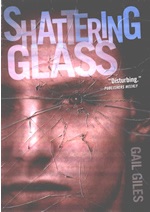
Shattering Glass

Module 8, SLIS 5420

Summary

Simon Glass is a nerdy, overweight guy and is picked on by some of the elite students at school, especially former king of the hill Lance. Rob has replaced Lance at the top of the male pecking order and decides to use Simon as a tool to humiliate Lance. Rob, a mysterious and charasmatic transfer student, enlists his friends, including Young, the narrator, to turn Simon Glass into a popular guy. He succeeds in changing Glass into a new person, accepted by almost the entire school, but have Rob and the gang underestimated the apparently timid and pliable Glass? What are the consequences for everyone involved?

Bibliographic Information

Giles, Gail. Shattering Glass. Simon Pulse, 2002. ISBN: 0-7569-1480-9

My Thoughts

This is a very disturbing book. There are hints throughout it in the introductions to every chapter that something bad is going to happen. The consequences for those involved are hinted at, as are the identities of those who are held responsible for what happens, but the facts are played out in the order in which they occur and the reader is teased into following along to the end to find out what actually happens. This is a very effective tactic on the part of the author. All of the characters are depicted as having very human qualities. No one person is entirely good and no one person is entirely bad. Together, their qualities and frailties help to contribute to a plausible and unfortunate ending. The reader is left to think about how the best laid plans can get out of hand, how difficult it is to anticipate the results of one's actions, and how those actions can affect one (and others) for the rest of their lives.

Reviews

Gr 9 Up-Gail Giles' debut young adult novel (Millbrook, 2002) makes a searing audio production as read by Scott Brick. His cold, calculating delivery style raises the tension on this already tense story about an in-group of high school seniors led by a true sociopath. Listeners can tell from an early scene involving torture of a laboratory animal that Rob means the most chilling sort of trouble for Simon Glass, class misfit. The story's narrator, Young Steward, a member of the clique, makes clear the grip Rob has on all his friends and focuses on his implacable intention to re-make Simon for purposes of his own. The violent frenzy Rob orchestrates ends in Simon's death after he shows signs of self-confidence that Rob can't allow. With a constant edge in his voice, Brick never lets up as he relates this riveting story. One somewhat problematic factor is the series of quotes from classmates and adults that introduce each chapter. As read, they are sometimes difficult to distinguish from the actual chapter narrative, leading to momentary confusion. The cover includes a list of chapters contained on each side of the tapes, a nice feature for finding a place in the text version. Reminiscent of Lord of the Flies, this is a story with mature themes focusing on the darkest side of human nature but in the most chillingly realistic of modern settings. The compelling writing is enhanced with convincing narration, but its intensity may give pause for thought.
Fenn, Jane P. School Library Journal. July 1, 2003.

By the end of the first paragraph, readers know that Simon Glass was easy to hate and that eventually he was killed. It takes the rest of the book to find out who killed him and why. Told in the different voices of students, teachers, counselors, and law-enforcement officers, the story unfolds little by little until the explosive climax. The reader soon realizes that the narrator of the story, Young, was one of Simon's classmates and is in prison for killing him, but it does not seem possible given the manner in which Young's character is portrayed. It soon becomes clear that Rob, Young's friend and unofficial group leader, is a master manipulator, pulling the strings of all the characters, influencing their actions to fulfill his master plan. In the early pages of the book, the language used by the students, the way they talk to and refer to each other might not seem authentic. After that initial reaction, though, as the suspense begins to build, readers will find it hard to put down the book. Robert Cormier's recent The Rag and Bone Shop (Delacorte Press, 2001/VOYA October 2001) explores the question of how a person can be influenced to do something that they ordinarily would not do. Although the plots of the two books are dissimilar, Giles's novel is also a chilling portrayal of manipulation leading to tragic consequences. Teens in upper middle school and high school will relate to the characters and, sadly, to some of the events in this book.
Roberts, Linda. Voice of Youth Advocates. June 1, 2002.

Awards

California Young Reader Medal

Suggestions for Use in Library

This would be a good candidate for helping students understand the dynamics of student popularity and the dangers of blindly following the advice or suggestions of fellow students. The story could be used to help students try to identify the motives of others and trace the consequences of not following one's own instincts.

Ace Lacewing, Bug Detective

Module 8, SLIS 5420

Summary
Ace Lacewing is a private investigator in the City of Motham. Mayor Buzzbee asks him to investigate the disappearance of Queenie Bee, a major town celebrity who endorses the products of the Hive Rise Honey Company. Ace follows a suspicious trail of warm honey from the scene of her apparent kidnapping to the factory of a honey-producing rival. What is going on here? Can Ace and his friends Dr. Xerces Blue and Sergeant Zito the mosquito solve the mystery and save Queenie?
Bibliographic Information
Biedrzycki, David. Ace Lacewing, Bug Detective. Charlesbridge, 2005. ISBN: 1-57091-569-5
My Thoughts
This picture book is beautifully illustrated, done in pencil and then colored using Photoshop. There is remarkable detail and little nuggets of humorous information imbedded in the art, such as through neon signs in the background and newspaper articles in the foreground. The latter might be seen in newspaper dispensing machines or in the hands of insect readers. Ace is the kind of detective who charges into danger without thinking about the consequences and Xerces has to save him from his enthusiasm. This is a nice introduction to mysteries for a younger reader. Along the way, the reader might also learn something about different types of insects.
Reviews

Gr. 2-4, younger for reading aloud. When Queenie Bee, of Hive Rise Honey, goes missing, Motham City is abuzz. Tough P.I. Ace Lacewing (Bad bugs are my business ) is on the case. Red herrings (mosquitoes, maggots, and walkingsticks in this case) abound, all with different stories, but the trench-coat-and--fedora-clad detective remains undaunted, sleuthing his way through the clues until a sticky surprise revelation. Biedrzycki ( The Beetle Alphabet Book, 2003) makes his debut as an author here, and although his story is sometimes text heavy, it's filled with snappy dialogue, wordplay, and puns that will especially appeal to kids with some knowledge of insects (words such as pupae are used). The slick, computer-assisted art has a cartoon flair; and its shadowy backgrounds have a noir flavor. Biedrzycki uses occasional pops of primary color and an array of perspectives and witty detail to add interest. Entertaining fare for those who appreciate creepy crawlies on the humorous side, this will attract both good readers and fans of seek-and-find books.
Rosenfeld, Shelle. Booklist. September 1, 2005.

Gr 1-4-Motham City is abuzz with the kidnapping of Queenie Bee, and Ace Lacewing, the Sam Spade of insects, is on the case. His motto is, "Bad bugs are my business." Lacewing follows the trail of honey with the help of his gal, Doctor Xerces Blue, and Sergeant Zito, a mosquito. A motley (and sometimes molting) assortment of suspects is questioned. Their character traits are based on facts: "The roaches said of course they ran from the scene of the crime-it was their nature to scatter when the lights go on." Puns and wordplay abound: "I've known him ever since we were pupae at the same school"; "The full moon hung in the sky like a large compound eye...." The digitally enhanced illustrations evoke a film noir atmosphere, with moody blue and black backgrounds. The pages are also brimming with humorous details such as glowworm street lamps, "Bug Off" police tape, and "Slow Larvae" road signs. This clever parody of hard-boiled detective stories is sure to tickle readers' thorax.
Ludke, Linda. School Library Journal. August 1, 2005.

Awards

North Carolina Children's Book Award (Nominated)

Suggestions for Use in Library

A teacher or librarian may use this book to work with children on identifying different types of insects, as there are many species used in the illustrations. Another use might be to identify different activities that various bugs are engaged in.

Friday, July 23, 2010

What If You Met a Pirate?

Module 7, SLIS 5420

Summary

Author/Illustrator Jan Adkins begins this book by comparing the image one is likely to have gained of the average pirate through movies or novels with that of the average pirate as seen through historical fact. He uses humorous language and imagery to help convey these differences. He then goes on to provide information about pirate ships, weaponry, and tactics in fighting (or avoiding!) battles in their quest for booty. He also provides information about the kinds of loot pirates were likely to find, how they might sell it, and how they spent their money. The life of a pirate was not like the glamorous image that Hollywood tries to sell to us in movies, and this comes across in the book. The reader will learn a great deal about actual pirates and the history of piracy, from the days of the Greeks until present times.

Bibliographic Information

Adkins, Jan. What If You Met a Pirate? Roaring Book Press, 2004. ISBN: 1-59643-007-9

My Thoughts

The subject of pirates is a very interesting one, especially to young boys. Who hasn't dreamed of finding pirate treasure? The author does a very good job of getting a great deal of factual information and history into a small package with this book. The illustrations are quirky and do not pull any punches. In talking about the horrific wounds and their causes, Adkins accompanies the text with illustrations that include scars, lost limbs, and ill-healed wounds. He also depicts the ships and weapons used by pirates and discusses their preferred tactics. He is also careful to point out historical inaccuracies that have crept into pirate lore over the years, such as the idea of "walking the plank." He also points out that pirates were a democratic existence, voting for captains or voting them out if they failed to please a crew. This is a good overview of what led men to turn to a life of piracy, and what life would be like for them.

Reviews

Starred Review. PreS-Gr 4Adkins begins with a stereotypical picture and description of a pirate, then proceeds to debunk the myths that surround these mysterious figures. Contrary to popular belief, pirates did not command large ships with guns and cannons, but preferred smaller, more nimble vessels so they could take victims by surprise and make a quick escape. Real pirates were as skillful with a needle as they were with a cutlass; most sewed their own clothes and mended sails. Packed with interesting but little-known facts, the text illuminates life on the high seas and answers many questions children may have: Did pirates force captives to walk the plank (no) or bury treasure (rarely)? Do pirates still operate today? Each of these questions and more are answered in spreads that include full-color spot illustrations, diagrams, and cross-sections. Adkins's detailed renderings will be as familiar to fans of his other nonfiction books as his tongue-in-cheek humor, both of which appeal to a broad range of ages. A fun and informative read.
Edwards, Laurie. School Library Journal. Date not given.

Gr. 3-5. Can it be that walking the plank was a fictional punishment invented by illustrator Howard Pyle? In this appealing book, Adkins gives readers the lowdown on what life under the pirate flag was really like. After setting up the conventional portrait of swaggering, singing sailors in colorful duds, he replaces it with a more realistic picture of hard-working sailors who might swashbuckle just a few hours each month and bathed considerably less. Yet this realistic portrayal of pirates and their activities is even more intriguing than the romanticized version he debunks. Adkins strikes just the right note in the text, always informative and frequently entertaining as well. Bright with color washes, the excellent, energetic drawings show pirates engaged in a variety of activities, from pumping out the bilge to braiding each other's hair to using the open-air bathroom at the front of the ship. In a send-up of current book marketing, the back cover carries appreciative comments by the likes of Queen Elizabeth I and Leonardo da Vinci. Where pirate fever runs high this spirited presentation will find an enthusiastic audience. For more titles, see the Read-alikes, Ship Ahoy!
Phelan, Carolyn. Booklist. October 15, 2004.

Awards

Utah Children's Informational Book Award

Suggestions for Use in Library

Children could be asked what they know or think they know about pirates. Then the teacher or librarian could work through the book to try to confirm or deny the gathered impressions.

Actual Size

Module 7, SLIS 5420

Summary

Steve Jenkins, the author and illustrator of this book, uses paper collages to create images of unusually small and large animals, or portions of them, to give the reader an idea of the varying sizes of animals found in nature. Sometimes, such as on the cover of the book, the images are transposed to give a sense of proportion between different species. Each entry includes information on the height and weight of the animal depicted. The end of the book includes a recap of the species mentioned in it, with more information about their habitat, habits, and what they eat. The illustrations are colorful and the use of collage helps to create a sense of texture in the images.

Bibliographic Information

Jenkins, Steve. Actual Size. Houghton Mifflin Company, 2004. ISBN: 0-618-37594-5

My Thoughts

This picture book has a mixture of animals that are scary and benign. Some are interesting to children because they are unusually small and others because they are unusually large. Some are simply interesting because children will have encountered them in their other readings and will be interested in seeing how big or small they are. In any case, they are unlikely to have actually encountered the given species covered in the book, as they are rather exotic to American readers. This list covers animals from all around the globe. The inclusion of more information about each species at the end is a nice touch, as readers will want to know more information about them. The individual entries in the rest of the book follow a predictable pattern that lends it a comfortable aspect.

Reviews

PreS-Gr 5-In striking torn-and-cut paper collages, Jenkins depicts 18 animals and insects-or a part of their body-in actual size. One illustration compares an atlas moth with a 12-inch wingspan to a dwarf goby fish, which is 1/3-inch long. The eye of a giant squid, at a foot across, occupies a spread to terrific effect; only the snout and tongue-curling its two-foot length across two pages and littered with termites-are visible in the picture of the giant anteater. The hand of a gorilla fills a page opposite the entire pygmy mouse lemur with its tiny human-fingertip-sized palm. The saltwater crocodile grows to 23 feet, so tremendous that its head occupies a three-page foldout. On the reverse side is the rat-eating Goliath frog, a staggering 36 inches long in full hop. One or two lines of text briefly introduce each animal and give specific measurements, e.g., the gorilla stands 5 1/2 feet tall and weighs 600 pounds, while the mouse lemur is 2 1/2 inches tall and weighs 1 ounce. The end matter offers full pictures of the creatures and more details about their habitats and habits. Mixing deceptive simplicity with absolute clarity, this beautiful book is an enticing way to introduce children to the glorious diversity of our natural world, or to illustrate to budding scientists the importance of comparison, measurement, observation, and record keeping. A thoroughly engaging read-aloud and a must-have for any collection.
Ratterree, Dona. School Library Journal. June 1, 2004.


Gr. 1-3. As in many of his previous bestiaries, including the Caldecott Honor Book What Can You Do with a Tail Like This? (2003), Jenkins' newest presents a parade of cut-paper animals, each accompanied by a pithy line of text. The difference here is the scale: everything appears at actual size. Jenkins' masterstroke, though, is his inclusion of creatures both great and small, so while petite critters fit comfortably within 12-by-20-inch spreads, larger ones appear as evocatively cropped bits and pieces: a gorilla's massive hand; a Siberian tiger's snarling mug; the unnerving, basketball-size eye of a giant squid. The resulting juxtapositions will leave children marveling at one species' daintiness, then shuddering as they mentally sketch in the unseen portions of more formidable beasts. Jenkins' artwork is gorgeous (a gatefold of a frog in midleap is particularly memorable), and, at the end of the book, thumbnail images of the featured animals paired with information about habitat and behavior put the piquant visuals into a broader context. An unusual, unusually effective tool for connecting children to nature's astonishing variety.
Mattson, Jennifer. Booklist. May 15, 2004.

Awards

Booklist Editors' Choice - Books for Youth- Young Readers Category

Suggestions for Use in Library

Children of all ages are interested in animals. This book is a useful way to intoduce the idea of comparing the size and weight of the unusual animals shown here with animals that the children are more likely to be familiar with, such as pets, people, and wildlife that live in their own geographic areas, or those they have seen in a zoo.

Friday, July 16, 2010

The Wednesday Wars

Module 6, SLIS 5420

Summary

Holling Hoodhood is left in a strange situation. His fellow Protestants in school have moved away, and the Catholic and Jewish students leave school on Wednesday afternoons for religious instruction. He, alone, is left with the teacher during this time, and he feels that his teacher, Mrs. Baker, hates him for this. At first he suspects her of siccing the school bully on him, but then he comes to believe that she is trying to wear him out through meaningless school chores like cleaning the erasures or the chalkboard. Eventually, she decides to use this time to teach him Shakespeare, and he loves it! He finds parallels in the stories with his own life and his previous love of Treasure Island. He finds the characters and their situations interesting and challenging. He comes to appreciate his time alone with his teacher. Their new relationship leads him into strange new experiences, such as performing in a Shakespeare production, excelling at cross-country track, and meeting famous baseball players. Along with the life and history lessons, there is a great deal of humor that the young reader will appreciate.

Bibliographic Information

Schmidt, Gary D. The Wednesday Wars. Clarion Books, 2007. ISBN: 978-0-618-72483-3

My Thoughts

In addition to the story of Holling's struggles in school on Wednesday afternoons, the reader is introduced to historical pieces of information about the Vietnam war and the toll it takes on families left behind. Walter Cronkite is a newscaster that many turn to for information about the increasingly distressing war. Wives turn to each other in support groups, dreading telegrams from the government/military about the status of their spouses.

Holling also learns lessons such as teachers can be more than they seem on the surface. Mrs. Baker is not only interested in literature like that of Shakespeare, but she also helps him to improve his form as a long distance runner on the track team, that rare underclassman that has the talent or knack to make the varsity team. She is a former olympic silver medal winner! Ultimately, this novel expresses hope and it is a good choice for not only learning about how to cope as a student, but how to excel. Along the way the reader learns some important history as well. This is told in a very funny style. The back story of the classroom rats is hilarious!

Reviews


Gr 5-8-This entertaining and nuanced novel limns Holling Hoodhood's seventh-grade year in his Long Island community, beginning in the fall of 1967. His classmates, half of whom are Jewish, the other half Catholic, leave early on Wednesdays to attend religious training. As the sole Presbyterian, he finds himself stranded with his teacher, Mrs. Baker, whom he's sure has it in for him. She starts off creating mindless chores for him but then induces him to read Shakespeare-lots of Shakespeare. Chapters titled by month initially seem overlong, relating such diverse elements as two terrifying escaped rats, cream puffs from a local bakery, his dad being a cheapskate/cutthroat architect, and Holling's tentative and sweet relationship with classmate Meryl Lee. The scary Doug Swieteck, and his even more frightening brother, and the Vietnam War are recurring menaces. A subplot involves a classmate who, as a recent Vietnamese refugee, is learning English and suffers taunts and prejudice. Cross-country tryouts, rescuing his older runaway sister, and opening day at Yankee Stadium are highlights. There are laugh-out-loud moments that leaven the many poignant ones as Schmidt explores many important themes, not the least of which is what makes a person a hero. The tone may seem cloying at first and the plot occasionally goes over-the-top, but readers who stick with the story will be rewarded. They will appreciate Holling's gentle, caring ways and will be sad to have the book end.

Shoemaker, Joel. School Library Journal. July 1, 2007


*Starred Review* On Wednesday afternoons, while his Catholic and Jewish schoolmates attend religious instruction, Holling Hoodhood, the only Presbyterian in his seventh grade, is alone in the classroom with his teacher, Mrs. Baker, who Holling is convinced hates his guts. He feels more certain after Mrs. Baker assigns Shakespeare's plays for Holling to discuss during their shared afternoons. Each month in Holling's tumultuous seventh-grade year is a chapter in this quietly powerful coming-of-age novel set in suburban Long Island during the late '60s. The slow start may deter some readers, and Mrs. Baker is too good to be true: she arranges a meeting between Holling and the New York Yankees, brokers a deal to save a student's father's architectural firm, and, after revealing her past as an Olympic runner, coaches Holling to the varsity cross-country team. However, Schmidt, whose Lizzie Bright and the Buckminster Boy (2005) was named both a Printz and a Newbery Honor Book, makes the implausible believable and the everyday momentous. Seamlessly, he?nbsp;knits together the story's?nbsp; themes: the cultural uproar of the '60s, the internal uproar of early adolescence, and the timeless wisdom of Shakespeare's words. Holling's unwavering, distinctive voice offers a gentle, hopeful, moving story of a boy who, with the right help, learns to stretch beyond the limitations of his family, his violent times, and his fear, as he leaps into his future with his?nbsp;eyes and his heart wide open.
Engberg, Gillian. Booklist. June 1, 2007.

Awards

ALA Notable Children's Books
Booklist Editors' Choice
Newbery Honor Books
Oprah's Kids' Reading Lists
Texas Lone Star Reading Lists
YALSA Best Books for Young Adults

Suggestions for Use in Library

Is a closer relationship with a teacher always a bad thing from a student's point of view? In what other ways can students learn from the experience of other adults in their lives? These are some questions that one can explore with reading assignments for this book.

The Teacher's Funeral

Module 6, SLIS 5420

Summary

Russell Culver is 15 years old and lives in rural Indiana in the early 1900s. He lives for the annual showcase of new, mechanized farm equipment that arrives each year on the train with all of the pomp and production of a circus. He dreams of running off with his friend Charlie to South Dakota to work in the fields and earn gobs of money. He does not live for school. During summer vacation he and his schoolmates learn of the death of their teacher, and they dream that is will take some time to replace her. After all, who would want to take over teaching so few students in their out of the way town in a simple, one room schoolhouse? Unfortunately for Russell, the answer is his older sister, Tansy. He suffers under her tutelage as she treats him like any other student. He cannot react to her like any other teacher, however, as they still live under the same roof with their parents. His father, especially, makes him respect his sister in her new role.

Russell has many adventures during the school year and his academic endeavors are stretched as his sister tries new teaching methods on all of the students, who are a rather mismatched bunch in both background and age. Russell comes to grudgingly respect the efforts of his sister and even root for her as she tries to earn her provisionary teachers certificate (she is only 17!)

Bibliographic Information

Peck, Richard. The Teacher's Funeral. Dial Books, 2004. ISBN: 0-8037-2736-4

My Thoughts

I was pleasantly surprised by this book. It is historical fiction set in a time that did not seem to have anything glamorous going for it. The attention to detail about rural life in that time made it a wonderful read. The one room schoolhouse filled with students mismatched in age and educational level really brought home what it was like to live in a time and place that did not necessarily place much importance on education. The 3-way efforts of the boys/men to win Tansy's heart added in turns a bit of comedy, drama, and suspense that was a welcome addition. Who will win, if anyone, in this competition?

Russell suffers some disappointments through the course of the story, such as learning that school will continue, and through the watchful eye of his own sister. He also must abandon his dream of leaving home to make money in the fields of the Dakotas. But he also learns that his family really cares for him and is watching out for his best interests. He first learns this is true in the character of his father, who seems to know every move Russell is about to make and then shields him from what would be his worst mistakes, helping him to discover why these actions would not turn out to help his own best interests. He also learns that while his sister Tansy is tough on him, her own motivation is to help him to meet his potential in life.

Reviews

This novel demonstrates the intelligence and integrity of VOYA's review system. To list Peck's ample achievement and awards would exhaust the word limit; suffice to say, Peck is the epitome of literary excellence and his latest book is no exception. Peck fills his coming-of-age story with vivid characters like Aunt Maud and dazzling use of vernacular in the book's voice and dialogue. Set in rural Indiana at the turn of the twentieth century, the reckons, Maws, and jists are stacked like rows of corn as Peck pulls readers inside life in a one-room school. After their teacher dies, fifteen-year-old Russell, his brother Lloyd, and their schoolmates hope that the school will be closed, but sadly a new teacher is hired, who just happens to be Russell's older sister Tansy. And that is when things get interesting-or do they? How will the Hee Haw humor play in a hip-hop culture? It is hard to imagine any teen reading this book unless already a fan of Peck's writing, not just because of the genre (historical fiction historically ranks low on teen reading surveys), but rather because of Peck's attraction with historical re-creation, not fast action or funny dialogue. Judgments about quality emerge from expertise, while popularity pronouncements stem from experience, but the book's subtitle, a comedy in three parts, obscures objectivity. Despite pratfalls and privy fires, there is plenty of corn here but little comedy. The cover of the book, like the comedy within it, was not seen.-Patrick Jones. With twists and turns and comedy in the middle, the author imparts his message that education is important when you want to achieve your dream. The book is written from the view of a fifteen-year-old, and I think that readers closer to that age will enjoy the book. I liked it because it was funny, and I enjoyed reading a tale about a boy who is against school (just like most of us).
David, Liza M. Voice of Youth Advocates. December 1, 2004.

Gr 6 Up-C'mon back to rural Indiana in 1904 and join 15-year-old Russell, whose summer ends with the unexpected death of old Miss Myrt Arbuckle. Russell and his younger brother are thrilled because just maybe the school board will decide to stop its foolishness and tear down the one-room schoolhouse. Surely it doesn't pay to hire a new teacher for the six students who attend. But to his utter horror, one is hired and it's none other than his extremely bossy older sister, even though she still has a year left of high school herself. Tansy takes to teaching with vigor and manages to circumvent all of the high jinx and calamities that threaten to undermine her authority, such as an accidental fire in the privy and a puff adder in her desk drawer. Peck expertly evokes humor and colloquial speech and mores with such sentences as "The water wasn't crotch-deep on a dwarf at that point," and "She had a snout on her long enough to drink water down a crawdad hole." Even readers who are blas? about current technological advances will be as excited as Russell is when he sees the steel Case Agitator threshing machine down from Wisconsin on its once-yearly exhibit, or the Overland Automobile Company's Bullet No. 2 racing car that can travel a mile in an unheard-of 43 seconds. Another gem from Peck-and a fabulous lead-in to titles such as Olive Burns's Cold Sassy Tree (Houghton, 1984).
Riley, Susan. School Library Journal. November 1, 2004.

Awards

ALA Notable Children's Books
YALSA Best Books for Young Adults

Suggestions for Use in Library

The Little House series features scences in a 1 room schoolhouse from a girl's perspective. This is another good book to explore what school was like in earlier days and in different circumstances, in this case from a boy's perspective. Compare and contrast. Are their experiences different? Superstitions also play a role in some of the "practical" jokes played in the book. Would these jokes work today?

Sunday, July 11, 2010

Ship Breaker

Module 5, SLIS 5420

Summary

Nailer is a 14-year-old who works on old, abandoned ships. His job is to remove valuable metal scrap from them, working with other youths to fulfill their quota for the bosses. The job is dangerous and it does not pay much. Still, it is better to belong to a crew who have exchanged oaths of belonging that to try to get by on one's own. Nailer lives with his father, Richard, a dangerous and violent man who is addicted to drugs and alcohol. The only good things in his life are his work with the crew and his friendship with Pima and her mother, Sadna. After falling into a hold full of oil and nearly dying from a wound from scrap metal, Nailer is considered a Lucky Boy, favored by the Fates.

A terrible hurricane hits their home, and Nailer and Pima set out to find some food. They discover a recent shipwreck. The wrecked ship is that of wealthy owners. They stash some loot they find and then discover a survivor. She is a rich girl named Nita. They nurse her back to health and she promises that her family will reward them for saving her. Before her people can rescue her, Nailer's dad arrives with some other toughs, taking the salvage and looking to sell Nita for ransom.

Nailer and Rita escape with the help of a half-man named Tool. They journey to the remains of the city Orleans to try and unite Nita with her people. There she is captured by Richard again, along with enemies of her father. Can Nailer find allies of Nita's family and help to rescue her? Can he escape his father's wrath?

Bibliographic Information

Bacigalupi, Paolo. Ship Breaker. Little, Brown and Company, 2010. ISBN: 978-0-316-05621-2

My Thoughts

Ship Breaker is definitely a book for Young Adults. There is a great deal of introspection on the part of Nailer that would be lost on younger readers. There is also a fair amount of violence. Nailer is forced into a conflict with one of his father's goons and must cut her throat to protect himself and Pima's mother. He also kills his father in self-defense. In between these acts, there is a great deal of speculation on Nailer's part regarding what is easy and what is right, and how his actions will affect his life and the lives of those he cares for. In the end, he finds a way to remove himself from his former life of despair and set himself on a path that may lead to better things, though there is no guarantee.

The world Nailer inhabits has suffered some kind of disaster of the climate, brought on by global warming. There is not a great deal of information given about what has happened, but it is revealed that the ice surrounding the North Pole has melted, polar bears are extinct, and there is a limit on carbon emitions and a return to ships powered by sail instead of oil. Also, hurricanes of category 6 are a regular occurence and have destroyed New Orleans and a subsequent attempt at rebuilding the city.

Reviews

Gr 7 Up-A fast-paced postapocalyptic adventure set on the American Gulf Coast. Nailer works light crew; his dirty, dangerous job is to crawl deep into the wrecks of the ancient oil tankers that line the beach, scavenging copper wire and turning it over to his crew boss. After a brutal hurricane passes over, Nailer and his friend Pima stumble upon the wreck of a luxurious clipper ship. It's filled with valuable goods-a "Lucky Strike" that could make them rich, if only they can find a safe way to cash it in. Amid the wreckage, a girl barely clings to life. If they help her, she tells them, she can show them a world of privilege that they have never known. But can they trust her? And if so, can they keep the girl safe from Nailer's drug-addicted father? Exciting and sometimes violent, this book will appeal to older fans of Scott Westerfeld's "Uglies" series (S & S) and similar action-oriented science fiction.
Bass, Hayden. School Library Journal. June 1, 2010.


*Starred Review* This YA debut by Bacigalupi, a rising star in adult science fiction, presents a dystopian future like so many YA sf novels. What is uncommon, though, is that although Bacigalupi's future earth is brilliantly imagined and its genesis anchored in contemporary issues, it is secondary to the memorable characters. In a world in which society has stratified, fossil fuels have been consumed, and the seas have risen and drowned coastal cities, Nailer, 17, scavenges beached tankers for scrap metals on the Gulf Coast. Every day, he tries to make quota and avoid his violent, drug-addicted father. After he discovers a modern clipper ship washed up on the beach, Nailer thinks his fortune is made, but then he discovers a survivor trapped in the wreckage the swank daughter of a shipping-company owner. Should he slit the girl's throat and sell her for parts or take a chance and help her? Clearly respecting his audience, Bacigalupi skillfully integrates his world building into the compelling narrative, threading the backstory into the pulsing action. The characters are layered and complex, and their almost unthinkable actions and choices seem totally credible. Vivid, brutal, and thematically rich, this captivating title is sure to win teen fans for the award-winning Bacigalupi.
Rutan, Lynn. Booklist. May 15, 2010.

Awards

None to date

Suggestions for Use in Library

This would be a good book for discussion amongst teens. There are several choices that Nailer makes in the course of the book that could be discussed. What are the consequences of making different decisions than the ones Nailer makes? What would you have done in his place, and why? Do you think the world in which Nailer lives is a possible future for mankind? Why or why not?

The Night Tourist

Module 5, SLIS 5420

Summary

Jack Perdu is a high school student who is a wiz at Latin, but does not have friends. He lives with his father, a professor, on the Yale campus. His mother died in an accident involving a collapsed scaffold. He is hit by a car and begins to see and hear extraordinary things. After finding his mother's name scrawled on an old map dropped by a man who then jumps out of a window, Jack finds himself examined by a strange doctor. Jack steals a golden token from his office but has no idea why he has done this. Killing time in the train station while waiting for his train home from the doctor's appointment, he befriends a girl his age who wants to show him some of the secrets of the train station. It turns out that his new friend, Euri, is a ghost, and she has brought him to the world of the dead underneath New York. His stolen token has granted him passage into this strange world. He and Euri begin to search for his mother, as she may still be there if she has not yet passed on to the Elysium, the realm of eternal peace.

Jack learns that he has only 3 nights in the underworld to find his mother. If he does not leave by then, he will have to stay forever. He and Euri must dodge the 3-headed dog Cerberus and his handlers, whose job is to protect the underworld from invasion by the living. Jack has some close scrapes with the "law", but he eventually finds his mother and learns the truth about her past and why she is still in the underworld. He has also learned Euri's secrets and he longs to get back to the world of the living and bring her with him. Can he succeed?

Bibliographic Information

Marsh, Katherine. The Night Tourist. Hyperion Books for Children, 2007. ISBN: 978-1-4231-0689-0

My Thoughts

This fantasy novel includes a well-thought-out world, the New York underground inhabited by the spirits of the dead. They have many freedoms, but there are also rules to their existence. For instance, they can only come out and visit the city above during the night. They cannot fly over water, etc. Many of the ghosts "haunt" sites that were important to them in life, keeping up with the goings on of their loved ones. Others attend entertainments like an NBA basketball game or a performance of The Producers, hovering high above the living spectators and performers. Jack experiences a great deal of confusion in this new world, and comes to rely on experienced ghosts like Euri and her friends. He also begins to see this experience as paralleling that of the tale of Orpheus, who in mythology visits the underworld to rescue his lost love. There is a great deal in this story that would appeal to young readers. Jack is on a quest, devoid of parental guidance, to try and find, and perhaps return with, his mother. He learns about the importance of friendship and perhaps finds his first love, though in a rather odd place. Finally, Jack learns of responsibility. Only he has the power to return Euri to the land of the living. He also has a responsibility to return to his father in the land of the living and let him know about the fate of his mother.

Reviews

Gr 7 Up-Jack Perdue, a prodigy, lives with his father on the Yale campus where he buries himself in classical literature. When an accident leaves Jack with a head injury, his father sends him to a very strange doctor in New York. Jack has not been to New York since his mother died and he and his dad moved to New Haven. In Grand Central Station, Jack takes a tour and meets a girl named Euri who suggests that he might want to see the underground station-places that the public never get to see. So begins the adventure into the underworld of ghosts as he searches for his mother and learns about her mysterious life and death. Adventure abounds as Jack and Euri visit with deceased authors and constantly avoid the ghost police with a three-headed dog looking for anyone who might be "living." Along the way, Jack discovers some truths about Euri, himself, and his father. Actor Andrew Rannels narrates and provides a realistic voice for each character. Harry Potter fans will enjoy this fantasy (Hyperion, 2007) by Katherine Marsh.
Actkinson, Jeana. School Library Journal. February 1, 2008.

Ninth-grader Jack lives with his father on the campus of Yale University. He is a Classics scholar who does not quite fit in with the other students in his class. After a near-fatal accident, Jack is sent to see a doctor in New York, the place where is mother died eight years ago. Jack meets a girl, Euri, who offers to show him the secret places in Grand Central Station. As she takes him down to the lowest levels, he discovers that they are in the underworld and that Euri is a ghost. Jack believes that it is his chance to see his mother again, but he only has three nights to find her before he must leave, all the while being chased by Cerberus, the three-headed dog who guards the underworld. Jack resolves his feelings of abandonment and helps Euri to realize that her family misses her. This quick read holds the reader's attention. Jack and Euri are likeable teens, trying to figure out where they fit into their worlds. Engaging characters such as Professor Schmitt, another Classics scholar, and poet Ruthven Todd help them in their quest to find Jack's mother and hide them from Cerberus. Marsh creates an interesting alternate world. Students who know classical mythology will understand and enjoy the allusions in the story. This unusual ghost story will appeal on many levels.
Dubois, Deborah L. Voice of Youth Advocates. December 1, 2007.

Awards

Edgar Allan Poe Awards: Best Juvenile Mystery Novel

Suggestions for Use in Library

This would be a good introduction to fantasy for students who are reluctant to test this genre. It is rooted in the real, contemporary world, with Jack visiting a new existence previously unknown to him. It might also serve as a good introduction to mythology, with readers/students following up with the adventures of Orpheus and their depictions of the underworld.

Friday, July 2, 2010

Hoot

Module 4, SLIS 5420

Summary

Roy is riding the bus to school one day when he spots a boy his age running along the sidewalk. Running faster than most could manage, and he does not seem to be on his way to school. This observation sets in motion a series of events that change Roy's life. He cannot get this boy out of his mind, despite the day-to-day irritations such as getting picked on by the school bully. He must pursue this and find out who this boy is! One day, after spotting the running boy again, he punches the bully in the nose in an effort to free himself enough to escape from the bus and try to follow the runner. This gets him into trouble with the school for "fighting" on the bus and skipping school. It also brings him into conflict with a girl soccer player who seems to be defending the running boy for some reason. Roy must defend his actions with officials at school, calm the angry soccer girl, find the runner, and fend off the angry bully. His actions bring him into the defense of small owls that live on a property about to be bulldozed for construction of a pancake house franchise as he joins forces with his new friend the running boy and his half-sister the soccer player. This is a funny book and the reader cannot help but be drawn into the story, learning a bit about the importance of environmental causes along the way.

Bibliographic Information

Hiaasen, Carl. Hoot. Alfred A. Knopf, 2002. ISBN: 0-375-82916-4

My Thoughts

Roy's father works for the federal Department of Justice in some capacity that is not explained, so the family must move across the country to his new postings on a regular basis. This means that Roy is always the new kid. After moving to Florida, he says he is from Montana, where he last lived and a place that he really enjoyed. This earns him the nickname "Cowgirl" with the school bully, who likes to torture him on the bus. Children who frequently move will appreciate how difficult it is to fit in when one is always moving. Roy seems to like a good mystery and cannot help himself in trying to figure out who the running boy is and why the soccer girl is trying to warn him away from finding out. This makes the story appealing to those that love a good mystery. Parallel to this is the story of the strange events at a nearby lot, slowing the progress of the building of a pancake house franchise and the efforts of the local police to stop the vandalism. The two stories merge as it is revealed that the running boy is trying to save a species of burrowing owl that lives on the property from unscrupulous developers. Roy's investigations, unwittingly aided by information from his father's background in law enforcement, lead the children and their schoolmates into a confrontation with the developers and the owls are saved. While the point of view is mostly Roy's, it does change now and then to include members of the police force who are investigating the vandalisms and to include conversations and reactions amongst the developers. This helps to introduce young readers to a more complicated and realistic style of fiction writing. The involvement of these youngsters in helping to prevent and environmental (and legal) wrong helps young readers appreciate how laws work and how anyone, however young, can help in a good cause. Along the way, Roy and his new friends bend or break a few laws. That is certainly a cause for concern. There is sufficient reflection on the possible bad concequences of these acts to help mitigate the inclusion of these scenes.

Reviews

Gr 6-9-This is novelist Carl Hiassen's first book for young readers (Knopf, 2002). Set in Florida, an intriguing barefoot runner reminiscent in his innocence of Maniac Magee leads middle school student Roy Eberhardt on an eco-adventure that includes snakes, fish, alligators, a student protest movement, and encounters with big business and law enforcement-all in defense of a nesting site for burrowing owls. This barefoot runner remains fairly enigmatic throughout the story, never truly becoming part of the ordinary world of home, school, and community that newcomer Roy finds so limited after having experienced the majestic Montana mountains. But Roy grows to appreciate Florida by experiencing it through contact with this elusive friend whom he helps to accomplish the seemingly impossible. An interesting cast of adult and student characters is brought to life by actor Chad Lowe who uses his voice deftly to express each in clearly discernible ways. His reading is especially well-paced to assist in following and understanding the changes of setting and characters as the plot moves along in two different sequences for quite some time. It's an appealing story focusing on ecological values, giving it nice classroom potential for science tie-ins. It would also make a great book for family listening because of its timely story line, interesting animal details, lots of local color, and effective message.
Fenn, Jane P. School Library Journal. January 1, 2003.

Gr. 5-8. It seems unlikely that the master of noir-tinged, surrealistic black humor would write a novel for young readers. And, yet, there has always been something delightfully juvenile about Hiaasen's imagination; beneath the bent cynicism lurks a distinctly 12-year-old cackle. In this thoroughly engaging tale of how middle-schooler Roy Eberhardt, new kid in Coconut Cove, learns to love South Florida, Hiaasen lets his inner kid run rampant, both the subversive side that loves to see grown-ups make fools of themselves and the righteously indignant side, appalled at the mess being made of our planet. When Roy teams up with some classic children's lit outsiders to save the home of some tiny burrowing owls, the stage is set for a confrontation between right-thinking kids and slow-witted, wrongheaded civic boosters. But Hiaasen never lets the formula get in his way; the story is full of offbeat humor, buffoonish yet charming supporting characters, and genuinely touching scenes of children enjoying the wildness of nature. He deserves a warm welcome into children's publishing.
Ott, Bill. Booklist. October 15, 2002.

Awards

ALA Notable Children's Books
Maud Hart Lovelace Book Award, Minnesota
Newbery Honor Books
Nutmeg Children's Book Award, Connecticut
Pennsylvania Young Reader's Choice Award
Rebecca Caudill Young Reader's Choice Book Award, Illinois

Suggestions for Use in Library

This would be a good choice for students or independent readers who are interested in making a difference regarding environmental issues. It might also interest those who move around frequently or just enjoy funny books. Finally, it would be a gentle introduction into books that have changing points of view.

Joey Pigza Swallowed the Key

Module 4, SLIS 5420

Summary

Joey Pigza lived with his Grandmother since his Father ran off and his Mother followed. His Grandmother was a lot like him: she had lots of energy and had trouble focusing. This made for a rather strange household and one that was rather messy. Then his Mother returned, bringing a level of stability, though Grandma and Joey still tended to bounce around the place. Joey has trouble at school, especially in the afternoons. He takes a medication to help calm him down, but it does not work so well after lunch. Because of this, Joey does not learn much in the afternoons and becomes quite a distraction to his teacher, Mrs. Maxy. He often is sent to visit the principal, Mrs. Jarzab, or Nurse Holyfield. Because of his frequent disruptions, the principal decides to try a new tactic: Joey will be sent to visit the Special Education room when he gets out of hand. The Teacher there, Mrs. Howard, has some methods of dealing with him that seems to help a little. When he is there, he meets the other children. Some have physical or mental difficulties that make him seem rather normal. Then, in regular class one day, Joey injures another student, accidentally cutting off the tip of her nose with scissors when he trips. This requires that he be moved to the school district's main Special Education facility. This turns out to be a blessing as they have the training and know-how to properly assess Joey's needs and help him through new medication and counseling to control his urges more successfully. He returns to regular school with a new appreciation for the conditions suffered by others in the Special Education program. He also gets a puppy to reward him for his transition!

Bibiographic Information

Gantos, Jack. Joey Pigza Swallowed the Key. Farrar, Straus and Giroux, 1998. ISBN: 0-374-33664-4

My Thoughts

Joey suffers from attention deficit disorder. The author does a good job of describing what Joey feels under the influence of this condition, both when his medications are working and when they are not. He also does a pretty good job of telling the story through the eyes of a 4th or 5th grader. He describes what he sees and what he feels about that, but it is obvious that he does not always understand and that he does not appreciate the long-term consequences of his actions. During the course of the book, while under treatment, Joey begins to reveal more about what he suffered at the hands of his Grandma. She also had attention deficit disorder and it was untreated, as she was a grownup and was merely thought of as eccentric. Some of her actions, such attempting to lock him in a refrigerator and pretending that his mother would come home immediately if he behaved himself, had profound and unfortunate effects on Joey's behavior and development. With counseling and a new medication structure, Joey returns to almost normal. Because of his condition, he can never be absolutely cured, but the reader sees the beginning of better things for Joey as he learns more about himself. His mother has also realized that she needs to make changes of her own if she intends to provide Joey with a safe environment in which he can grow and develop. This book is a good introduction to attention deficit disorder for those that do not suffer from it, but who may know others that do. It is also a tale of courage for those who have the disorder. In the character of Joey they can see hope for themselves.

Reviews

Joey Pigza is hyperactive and ADD (Attention Deficit Disorder), and he knows it. Being wired is something that runs in his family; Joey's father skipped out when Joey was in kindergarten. His mother left shortly afterwards, abandoning Joey to the dubious care of a batty and abusive grandmother. For years Joey lived in chaos, until his mother came home sobered up and determined to take care of him. The trouble is that the meds Joey takes to control his condition work only half a day, and when they wear off he is quite literally off the wall, impossible in a classroom and a menace to himself and others. When Joey precipitates an accident that seriously injures a classmate, he is sent to a special education school?here, as Joey observes, the kids arrive punished already with crippling handicaps. The school marks another turning point for Joey. A supportive caseworker helps Joey deal with and understand his disability, and he is put on a continuous release patch that evens out the delivery of his drugs. Joey returns to his old school feeling calmed down, hopeful, and even a little good about himself. Joey; his gutsy, struggling mother; and his long-suffering teachers come to life in this highly readable novel that is sometimes funny, sometimes heartrending, and both entertaining and engrossing. Be aware, though, that the plot and a lot of Joey's inner dialogues hang on the drugs that do or do not control his condition. Readers uncomfortable with the way that medicines are used to control children's behavior are going to have qualms about this story. There are plenty of Joeys in schools today, and it is good to have one of their stories told with such skill and sympathy.
Patton, Anya. Voice of Youth Advocates. February 1, 1999.

Gr 5-8-Joey Pigza suffers from severe attention deficit disorder and struggles to remain calm when his world chaotically slips through his fingertips. When his medicine wears off, he cannot concentrate or sit still and is constantly in trouble at school. After leaving him for several years in the care of his abusive grandmother, his mother returns to reclaim him and her parental responsibilities. But Joey remains a challenge: he continually disrupts his class, swallows his house key, and runs away during a field trip. Eventually, he injures a classmate and is sent to a special education center for six weeks; here his medication is regulated and he learns how to manage his behavior. Joey leaves the center feeling strong and in control and he triumphantly returns to his old school. Gantos creates a strong cast of multidimensional characters. Joey is inherently a good kid and just as his teachers want him to succeed, readers will empathize and feel his emotional and physical bruises. References to alcoholism and abuse add realism to the novel without impeding the flow of the plot. In his first-person narrative, Joey relates incidents that are heart wrenching and humorous. From the powerful opening lines and fast-moving plot to the thoughtful inner dialogue and satisfying conclusion, readers will cheer for Joey, and for the champion in each of us.
Brommer, Shawn. School Library Journal. December 1, 1998.

Awards

ALA Notable Children's Books
California Young Reader Medal
School Library Journal Best Books
Virginia Readers' Choice Award

Suggestions for Use in Library

This would be a good book to suggest for anyone suffering from Attention Deficit Disorder. It would also make a good class assignment in situations where children are expanding their awareness of conditions that others suffer. I would add that caution be exercised as to not make it to obvious or awkward for fellow students who have this condition if this is made a class assignment!

Sunday, June 27, 2010

Bud, Not Buddy


Module 3, SLIS 5420
Summary
Bud is living in an orphanage after the death of his mother. He has never known his father. He keeps his possessions in a battered old suitcase. Among his favorite things are some old flyers for concert appearances featuring Herman E. Calloway. Bud believes that Calloway must be his father because of the way his mother used to look at the flyers. When his latest foster home situation results in abuse, he runs away, determined to find his father. He has adventures in trying to get to Grand Rapids, where he hopes to find Calloway. His attempt to hop a train fail, but he meets some interesting people along the way. Next he tries to walk there, but is brought back to Flint by a well-meaning man named Lefty. Eventually, Bud is taken straight to Herman E. Calloway by Lefty. Calloway and his fellow musicians are very surprised by Bud's story. Calloway denies being Bud's father and is very skeptical of his story and his aims. The rest of the band are more sympathetic and work to get him added to the group in return for his doing chores and learning to play an instrument. Among his other possessions, Bud had a collection of rocks labelled with the dates and places where they were found. The rocks had been important to his mother, so Bud treasured them as well. In his travels with the band, Bud discovers that Calloway collects rocks and labels them exactly like the ones he has in his collection. Thinking this is proof that Calloway is his father, Bud shows his collection to him. Calloway is distressed, thinking that Bud has stolen some of his collection. A photograph of his mother that Bud has kept is the final link to the puzzle of who he is...Bud is not Calloways son, but his grandson! Bud's mother was Calloway's missing daughter, who had run away to get married and never returned.
Bibliographic Information
Curtis, Christopher Paul. Bud, Not Buddy. Delacorte Press, 1999. ISBN: 0-385-32306-9
My Thoughts
I really liked the way the story is told through Bud's impressions. Some of the words he thinks are misspelled in a way that is completely believable in someone his age and from that time period. He also has some endearing superstitions that help to make his character believable, such as mistaking Lefty for a vampire because he is transporting blood to a hospital for an operation. In his journeys Bud visits the library to learn how to get from Flint to Grand Rapids. He has pleasant memories of the times he spent in the library with his mother, and indeed he is remembered there. This helps the reader think of the library as a good place. Bud also visits a soup kitchen and we learn interesting details about how they operate and how important they were to starving people during the Great Depression. Bud also visits a shantytown in an attempt to hop a train to go west. There, the reader learns details about how the poor would band together and help one another out in those tough times. There, Bud also experiences his first kiss. Another detail that I found interesting was the information regarding Calloway's band. Bud describes each one in detail, along with their colorful nicknames, indeed he receives one of his own, helping to cement his relationship and a member of the group. Another interesting point is that Calloway keeps a token white person in the band in whose name real estate is kept, as blacks are not permitted to own real estate in some areas of the city! Bud delights in hearing them play for the first time and longs to join them in making such beautiful music. He has found a home. The reader rejoices with him as he discovers that this is where he truly belongs now.
Reviews

Curtis's magical touch in his debut novel, The Watsons Go to Birmingham-1963 (Delacorte, 1995), is once again evident in all its powerful, funny glory in his latest lovely novel. Ten-year-old Bud Caldwell, wise beyond his years, is hit particularly hard by the Depression in 1936. Bud has been bounced back and forth between a Flint, Michigan, orphanage and foster care since his mother died when he was six. Fed up with beatings from those who take him in, Bud grabs his few meager treasures and sets out in search of his father. With determination and a cautious but curious spirit, Bud heads for Grand Rapids, home of Herman E. Calloway, legendary bass player and leader of a renowned jazz band. Convinced that Calloway is his long-lost father, Bud seeks a reunion. Bud's only guidebook is Bud Caldwell's Rules and Things for Having a Funner Life and Making a Better Liar out of Yourself, his own set of poignant, riotous tips for preserving sanity. In a scene of stunning hilarity, Bud is rescued by Lefty Lewis, who takes Bud to Grand Rapids, where the child learns yet again that life is not always what it seems. Curtis writes with a razor-sharp intelligence that grabs the reader by the heart and never lets go. His utterly believable depiction of the self-reliant charm and courage of Bud, not Buddy, puts this highly-recommended title at the top of the list of books to be read again and again.
Andersen, Beth E. Voice of Youth Advocates. February 1, 2000.

Gr 4-7-When 10-year-old Bud Caldwell runs away from his new foster home, he realizes he has nowhere to go but to search for the father he has never known: a legendary jazz musician advertised on some old posters his deceased mother had kept. A friendly stranger picks him up on the road in the middle of the night and deposits him in Grand Rapids, MI, with Herman E. Calloway and his jazz band, but the man Bud was convinced was his father turns out to be old, cold, and cantankerous. Luckily, the band members are more welcoming; they take him in, put him to work, and begin to teach him to play an instrument. In a Victorian ending, Bud uses the rocks he has treasured from his childhood to prove his surprising relationship with Mr. Calloway. The lively humor contrasts with the grim details of the Depression-era setting and the particular difficulties faced by African Americans at that time. Bud is a plucky, engaging protagonist. Other characters are exaggerations: the good ones (the librarian and Pullman car porter who help him on his journey and the band members who embrace him) are totally open and supportive, while the villainous foster family finds particularly imaginative ways to torture their charge. However, readers will be so caught up in the adventure that they won't mind. Curtis has given a fresh, new look to a traditional orphan-finds-a-home story that would be a crackerjack read-aloud.
Isaacs, Kathleen. School Library Journal. September 1, 1999.

Awards

ALA Notable Children's Books
Coretta Scott King Award
Grand Canyon Reader Award, Arizona
International Reading Association Children's Book Award
Land of Enchantment Book Award, New Mexico
Mitten Award, Michigan
Nene Award, Hawaii
New York Times Notable Books
Newbery Medal
Parents' Choice Awards
Pennsylvania Young Reader's Choice Awards
Prairie Pasque Children's Book Award, South Dakota
School Library Journal Best Books
William Allen White Children's Book Award, Kansas
Young Reader's Choice Award, Pacific Northwest

Suggestions for Use in Library

This is a good choice for learning about the history of poor people in the Great Depression. It could be read aloud along with questions about the content that might ask for comparisons with the plight of the homeless today. It is also a good subject for discussing the powerlessness of children caught up in the orphanage/foster care system.

Saturday, June 26, 2010

How I Live Now


Module 3, SLIS 5420

Summary

"Daisy" (really Elizabeth, but she hates the name) finds herself in present day England, sent away by a family that seems indifferent, just in time for a war that breaks out and strands her from her native New York City, her cell phone, and her email connections to friends. Among her cousins on an English farm, they are on their own and without supervision to live through a war that has isolated them from such things as regular access to outside food and reliable information. She falls in love with her cousin Edmond and they are separated by the British Army under orders from an unidentified occupying force. She longs to return to the farm and be with Edmond again, and escapes to do just that, but upon returning to the farm, is dragged back to her family in America. Her efforts to return to the farm help her to grow as she must not only get herself back, but also her young cousin Piper. After the war, she returns to England and tries to repair her relationship with an Edmond broken by his experiences in the war.

Bibliographic Information

Rosoff, Meg. How I Live Now. Wendy Lamb Books, Random House Children's Books. 2004. ISBN: 0-385-74677-6

My Thoughts

Daisy comes across in this book as a very real character. She is thin and is sensitive to the remarks of others about her eating habits (read anorexia) but that is not really thrown in the face of the reader. In the course of the book, faced with real starvation, Daisy comes to value food. She is troubled by her strange telepathic relationship with Edmond and her need to be with him. It drives her need to return to the farm and reunite the family. She feels closer to her cousins in England than she ever did to her family in the US, and so she returns after the war to help Edmond find himself again. The language used in the book is believable as coming from someone of Daisy's age and experience as are her thoughts and motivations as people her age are a strange mixture of child and adult. While her relationship with her cousin is troubling from an incest point of view, and the relationship develops into the physical, it is not terribly graphic, unlike some other works for this age group. Many of Daisy's thoughts are related in capital letters to give them emphasis.

Reviews

Gr 8 Up- Daisy, 15, a troubled New York City teen with a distant father, a wicked (and pregnant) stepmother, and an eating disorder, is sent to England to stay on a rambling farm with her deceased mother's sister's family. It is made up of Aunt Penn "who always has Important Work To Do Related to the Peace Process" and her brood of children: Osbert, 16; 14-year-old twins Isaac and Edmond; and 9-year-old Piper. As the kids spend more and more time together, Daisy warms to them, beginning to tune in to a seemingly psychic bond that the siblings share. When Aunt Penn travels to Oslo, Daisy begins a sexual relationship with Edmond. At the same time, hostile forces invade England. Originally enjoying the freedom of a world that seems to have forgotten them, the cousins are inevitably separated, leaving Piper and Daisy to struggle across the countryside and rejoin the others. Daisy's voice is uneven, being at times teenage vapid, while elsewhere sporting a vocabulary rich with 50-cent words, phrases, and references. In addition, Rosoff barely scratches the surface of the material at hand. At times, this is both intentional and effective (the enemy is never named) but for the most part the dearth of explanation creates insurmountable questions around the basic mechanisms of the plot. There is no explanation of how a small force could take out all communicatins (including cell phones) and proceeed to overrun and to control an entire country. Perhaps even stranger, the ramifications of psychic abilities and underage sexual relationships between fiirst cousins is never addressed.

Davey, Douglas, P. Booklist. September 1, 2004.

Gr 8 Up- Impending war, parental rejection, and anorexia are Daisy's concerns as she steps off the plane in England where she's been sent to stay with her Aunt Pen and her four cousins. The 15-year-old has landed in a chaotic but supportive country household where she is immediately intrigued by her cousin Edmund.In this novel (Wendy Lamb Books, 2004), Meg Rosoff explores what happens when war leaves these five youngsters to fend for themselves. There are the hardships of finding food and the loss of their mother, but there is also freedom and unexpected tenderness that evolves into an intense physical relationship between Daisy and Edmund. When the two are parted, Daisy takes charge of her youngest cousin, Piper, and the two young women set off to find Edmund and his twin Isaac. What they discover is a brutal massacre but not their kin. Finally returning to the family home, the two girls spend every waking minute trying to survive until Daisy's dad forcibly extricates her from England. It's many hears before all of them are reunited. (misspellings intentionally duplicated from original source, KP)

Wysocki, Cora J. School Library Journal. August 1, 2005.

Awards

Booklist Editor's Choice - Books for Youth

Michael L. Printz Award

YALSA Best Books for Young Adults

Suggestions for Use in Library

This would be a good discussion opener for the topics of incest and the genetic difficulties that might occur because of it. Also, it might be used to discuss anorexia. Finally this book could be paired with Lord of the Flies to discuss behavior without parental control.

Sunday, June 20, 2010

Space Station Mars

Module 2, SLIS 5420
Summary
The boys from Oak Hills become keen on things extraterrestrial after seeing the movie Invaders from Mars. They share ideas on the existence of space aliens, shooting stars and meteorites. They uncover a rock they believe is a meteorite in a neighbors yard and enlist the help of a new boy visiting for the summer, Neil. Neil is a budding scientist and he subjects the rock to chemical tests, determining that it originated on Mars. The boys' excitement is palpable and they turn their clubhouse into Space Station Mars using Neils telescope and star charts to comb the night sky for evidence that We Are Not Alone. After overhearing a conversation about a strange new structure spotted nearby, the boys investigate and conclude it must be a spaceship from Mars. They decide to return the meteorite from Mars as a gesture of goodwill between neighboring planets. They hand to rock over to the "aliens" they meet and run away, mission accomplished.
Bibliographic Information
San Souci, Daniel. Space Station Mars. Tricycle Press, 2005. ISBN: 1-58246-142-2
My Thoughts
This book will definitely appeal to young boys. The sense of adventure shared with old and new friends is contagious, with the boys eager to explore and learn about things from other worlds. The book depicts the boys as industrious, redecorating the clubhouse themselves as they transform it into Space Station Mars. They are independent, relying on themselves (for good or bad) for information about the world beyond. And of course, they are completely wrong about the alien spaceship. It is actually a new water tower and the two painters (aliens) they encounter with respirators and paint guns are confused by the gift of the rock. It is a funny ending to an interesting story and the reader will be eager to read other books in the publisher's Clubhouse Book series. The artwork is colorful and realistic, setting the story sometime in the late 1950s or early 1960s. The "scientist" Neil is unfortunately depicted stereotypically, with thick glasses and labcoat as are the pictures of aliens with green skin and bulbous eyes, but then, that is what you would expect from a story about that period in time. The author includes information about the inspiration for the story, including a photograph of the real water tower, at the end. The books also depicts Neil as writing a letter to the group in code after going back home at the end of summer. The reader is given the key to decript the code and is encouraged to visit a Web site for further activities related to the series of books, all of which are nice follow-up touches that help the curious reader learn more and engage enthusiasm.
Reviews
Gr 1-4 - The boys from The Dangerous Snake and Reptile Club (Tricycle, 2004) are back. After watching a movie about space aliens, the kids are convinced that a rock found in their neighbor's backyard is really a meteor from Mars. They quickly transform their clubhouse int Space Station Mars. Luckily, Neil is an expert on extraterrestrials. He uses his chemistry set to test the meteor for radioactivity and monitors intergalactic communication with his crystal radio. When he picks up strange transmissions, the club members are convinced that the Martians who lost the meteor are on their way back to reclaim it. They find the "alien spaceship" and return the rock to "alien visitors." This book captures the wonderful time in children's lives when the line between reality and imagination is blurred. The boys are able to have great adventures because they believe in what they are playing. The bright cartoon illustrations, which are chock-full of detail and activity, increase the sense of fun. This is a great choice for independent reading or sharing aloud.
Cardon, Donna. School Library Journal. October 1, 2005.
Awards
Blue Hen Book Award, Delaware: Picture Book
Suggestions for Use in Library
This would be a wonderful book to spark discussion about falling stars and meteorites. The book also includes information about the popularity of crystal radio sets made using simple materials. If a science teacher or librarian can still find such materials, putting together a crystal radio would make an interesting related activity. Also, a teacher or librarian could introduce children to a real, working telescope.