Thursday, August 12, 2010

Amelia Rules! Superheroes

Module 10, SLIS 5420

Summary

Superheroes is the third installment in the Amelia Rules! series of graphic novels. In this one, Amelia and her friends come into conflict with the Park View Ninjas, a group of rival kids who dress and act like ninjas instead of superheroes, like Amelia's friends. Their contact comes about within the framework of Amelia's mother wanting to move into a house in Park View. The Ninjas manage to mislead the Superheroes into believing that there was a third group, the Legion of Steves, responsible for a great conspiracy throughout history. The Legion of Steves is supposed to be responsible for most of the ills that have beset humanity, and Reggie, leader of the Superheroes, vows to bring them down. The book is very funny and filled with action and humor as the various characters fantasize about how they would deal with their daily lives and their superhero identities, slipping between those fantasies and the real world. But all is not well in Amelia's world. She and the Superheroes, and their new friends the Ninjas, befriend a girl named Trish who writes for the neighborhood fan-zine Tweenie Zeenie. Amelia discovers that Trish has a congenital heart problem and is in a very fragile condition. She should not be participating as a new member of the Superheroes. This book takes a lighthearted look at the creative imaginations of tweens, poking fun at their vulnerabilities and passions, yet shows that sometimes the serious side of life intrudes, and that getting through these difficulties, through sharing experiences of all kinds, kids can help each other and make a difference in one anothers lives in meaningful ways.

Bibliographic Information

Gownley, Jimmy. Amelia Rules! Superheroes. Renaissance Press, 2006. ISBN: 0-9712169-7-5

My Thoughts

This is a good series to use in introducing tweens and reluctant readers to the graphic novel format. The characters are appealingly real. Readers will recognize people they know or have known in the characters. The art is well done and fits seamlessly with the text. The expressions and the body language of the characters helps the reader understand the emotions of the characters. The character of PajamaMan is especially amusing as his emotions and reactions can be read in the exclamation points and question marks that appear on his pajama tops. It is a book that is both fun and serious in a way that does not talk down or condescend to tweens. Fantasy sequences are tipped off with transitions that are dream-like, such as a switch to black and white, characters becoming insubstantial, or a lack of detailed background scenery.

Reviews

Gr. 4-7 In this third volume of the Amelia Rules! series, the school year has ended, but summer isn't carefree. Amelia must deal with the possiblity of moving out of the neighborhood; then her new friend Trish hides a terrible secret within the fantasy adventure she is writing. The real drama of the story, however springs from the dare Amelia takes while playing Truth or Dare. Gownley continues to blend slapstick comedy with serious, poignant issues in a way that will draw a wide age range, and his colorful, kid-friendly art, in simple yet sophisticated panel layouts, will keep readers going forward with the story.
Kan, Kat. Booklist. September 1, 2007.

Awards

Cybils Award (bloggers)

Suggestions for Use in Library

This is an appealing introduction for tweens or reluctant readers to the wonders of graphic novels. It is both funny and deals with the complex issue of dealing with a potentially fatal physical infirmity. It also tackles issues associated with shifting friendships. Discussions could focus, either with an entire class or focus groups on the illness and friendship issues.

Wednesday, August 11, 2010

Amulet: The Stonekeeper

Module 10, SLIS 5420

Summary

Emily and her family move to a new, spooky house after her father dies in a car accident. Emily and her brother, Navin, discover an amulet in a hidden room of the house formerly occupied by their great grandfather, Silas Charnon. A mysterious, ghostlike entity seems to watch them. Strange sounds in the night entice their mother into caverns below the house, where she is swallowed by an evil creature. The amulet begins to speak to Emily, telling her what she must do to save the ones she loves from evil. Can the amulet save her and her family? Will the power it gives her extract a terrible price?

Bibliographic Information

Kibuishi, Kazu. Amulet: The Stonekeeper. Graphix, 2008. ISBN: 978-0-439-84680-6

My Thoughts

This is a nice introduction to a new series. I do not know if it appeared anywhere before this, but the chapters are well-organized and they space the background and current action well. Most of the story is told through the illustrations and they do a very good job, though the sounds expressed are rather unconventional and can be distracting because of this. The panels take a little getting used to because of their arrangement. Some go down, others go across. Figuring this out is fairly intuitive. The illustrations are very rich in color and tone. The book ends with a cliffhanger that leaves the reader wanting more.

Reviews

Gr 4 Up. Hurrying to pick up her brother, Emily and her parents have a tragic accident, and her father dies. After this dark beginning, the story skips forward two years to when the remaining family members are forced to move to an ancestral house in a small town. Rumored to be haunted, it is unkempt and forbidding. The first night there, Emily's mother goes down to the basement to investigate a noise and doesn't return. The kids search for her and discover a doorway into another world, where their mother has been swallowed by a monster and is being taken away. An amulet that Emily found in the house tells her that together they can save her, but her brother isn't so sure that this voice can be trusted. Still, what other choice do they have in this strange place? Gorgeous illustrations with great color bring light to this gloomy tale. Filled with excitement, monsters, robots, and mysteries, this fantasy adventure will appeal to many readers, but it does have some truly nightmarish elements.
Rutherford, Dawn. School Library Journal. January 1, 2008.

Kibuishi, the creator of the action-packed Daisy Kutter series, sets his sights on a slightly younger crowd here. This first volume in the new Amulet graphic novel series introduces Emily, who has relocated to a strange house in the woods, where she finds a magical amulet left behind by her great grandfather. Soon after, she and her brother engage in a wild adventure to learn the secrets of the amulet and save their mother. Emily is as?nbsp;high-spirited a heroine as you are likely to find, and, propelled by uncluttered visuals,?nbsp;her?nbsp;action-packed adventure sequences move at an exciting clip. However, there?nbsp;are?nbsp;also dark elements in the tale the gut-wrenching opening?nbsp;in which?nbsp;Emily loses her father in a car accident. the autumnal tones of the animation-like art, and the ambiguous agenda of the amulet itself.?nbsp;Part fantasy (anthropomorphized animals, elves) and part manga (transforming robots, tentacled monsters), this volume?nbsp;has much to appeal to readers, though?nbsp;they may be in for a more emotionally complex read than expected.
Karp, Jesse. Booklist. December 1, 2007.

Awards

Surrey Schools' Book of the Year Award (British Columbia)

YALSA Best Books for Young Adults

Suggestions for Use in Library

This book has action, it has mystery (regarding the origin of the amulet and the fate of Emily's great grandfather, and it has a quest for saving the mother. All of these are great motivators for reluctant readers and teachers and librarians can use it for that purpose.

Thursday, August 5, 2010

More Bones: Scary Stories From Around the World

Module 9, SLIS 5420

Summary

This is an interesting collection of international ghost stories and scary tales. The stories are short and most of them can be read within 5 minutes. The stories are from Europe, Asia and the Middle East. They are nicely (and creepily) illustrated by E.M. Gist. The cover art is attractive to those who appreciate the macabre and the volume is not so large as to discourage timid readers. Almost all of the stories fall into the category of cautionary tales. The participants have choices to make and the wrong decisions can lead to dire consequences.

Bibiographic Information

Olson, Arielle North, and Howard Schwartz. More Bones: Scary Stories From Around the World. Penguin Young Readers Group, 2008. ISBN: 978-0-670-06339-0

My Thoughts

The stories included in this book are a nice cross-cultural look at was scares people around the world. What is most striking about them is how well they work in scaring a reader from any culture. It shows the reader that fear of the strange and supernatural is something that crosses cultural boundaries. We are all hardwired to appreciate the spooky. As cautionary tales, these stories also support the idea that if something on the surface seems like too good a deal, there is probably something wrong with it. This makes for a nice supportive lesson in real life, despite the supernatural sources of the themes.

Reviews


A sequel to Ask the Bones (1999), this tour of the world's shadowy corners is full of dark wizards, unkind witches, and other untrustworthy creatures. No matter if the stories originate from Ireland, Iceland, China, or Turkey, they all offer up similar lessons:?nbsp;don't try to outsmart magical beings, for example. The 22?nbsp;tales, as retold by Olson and Schwartz, give a vivid glimpse into unfamiliar, unnerving territory, but they are short, so they won't?nbsp;draw young readers too deeply into nightmarish worlds. The atmospheric?nbsp;illustrations, while not intricately detailed, are somewhat startling in their imagery: a skull featuring a single, staring eyeball or a close-up of an aggressive rat's snarling head. Olson and Schwartz sometimes end their stories with a direct question that adds more shivers; after one tale about a skull that is searching for a new family to haunt, the text asks, How about yours? In other selections, plot twists, transformations, and other mysteries are left to be pondered over, probably at bedtime. Full source notes for the stories are provided in an appendix.
Nolan, Abby. Booklist. October 1, 2008.

Gr 4-6-According to the source notes, many of these 22 selections are drawn from 19th-century collections. The assortment ranges from stories that utilize traditional folktale elements such as granted wishes, witches, and wizards to others featuring ghosts and corpses. "The Headless Horseman" (Ireland), "The Shaggy Gray Arm" (Iceland), "The Werewolf in the Forest" (Eastern Europe), and "The Ghost of the Rainbow Maiden" (Hawaii) are among the creepy entries. Gist's dark, smudgy illustrations may prove more frightening than the tales themselves. Give the book to fans of Alvin Schwartz's "Scary Stories."
Slagenwhite, Laurie. School Library Journal. September 1, 2008.

Awards

None listed.

Suggestions for Use in Library

Teens and tweens that enjoy good scary stories would enjoy this book. It makes a good choice for independent reading in that the reader can easily pick up where he or she left off within the book. It would also make a good choice for anyone with little time to spend at any given moment on reading and enjoys a scary story. A final use could be as a cross-cultural exploration of what scares readers.

Wednesday, August 4, 2010

Rubber Houses


Module 9, SLIS 5420


Summary


Kit remembers her 9-year-old brother, who dies of cancer. She relives their shared love of baseball and math, but mostly baseball. The novel is told in free verse, and the individual poems tell of her progression through the steps of remembrance and grief. Her daily life, as she works through her grief in interacting with family and friends is very moving. Kit's reactions are filtered through a full year, given in terms of a baseball season/off-season, in telling the story.


Bibliographic Information


Yeomans, Ellen. Rubber Houses. Hachette Book Group USA, 2007. ISBN: 978-0-316-10647-4


My Thoughts


This is a very moving book. The short poems that make up the text allow the author to pack a great deal of emotion and imagery into the passages in snippets. The narrator's feelings about the loss of her brother and the changes in her relationsionships with her family and friends come accross very effectively in this medium. The imagery that Kit projects through words describing family as team and baseball diamond as home is touching given her shared love of the game with her dead brother, Buddy.
Reviews

When Kit is a junior, her little brother, Buddy, who loves baseball and math, is stricken with cancer. Her fun-loving high school world and reasonably happy family life are turned on end. As Buddy's illness intensifies, so does the turmoil and tension that the family experiences, and when he dies the summer before her senior year, everything falls apart for Kit. She and her parents have a terrible time coping with their loss, until they can find a way through their grief. For Kit, a teen bereavement group, a new job at a hardware store, and a reconnection with her best friend help her begin to bring her life back together. This realistic, sad, sparingly written yet powerful verse novel brings into focus a terrible ordeal that can sideswipe a family. Kit is a well-drawn character, a loving sister who cannot fathom the loss of her beloved sibling but who must. She must also learn to cope if she is to survive, and when she begins to regain her life the reader will want to cheer. Those drawn to Sonya Sones's Stop Pretending: What Happened When My Big Sister Went Crazy (HarperCollins, 1999) and Jordan Sonnenblick's Drums, Girls, and Dangerous Pie (Scholastic, 2005/VOYA December 2004), will find similar intensity and pathos here.-Diane Tuccillo. Kit, a typical teenager, lives with her parents and younger brother, Buddy. Her life is a normal one with friends, boys, her brother, and baseball. Kit and Buddy, despite their eight-year age gap, are extraordinarily close. When Buddy develops cancer, however, Kit's life changes forever. Written in beautiful, sparse poetry, Rubber Houses is a heart-wrenchingly captivating novel.
McQuarrie, Oonagh. Voice of Youth Advocates. February 1, 2oo6.

Sixteen-year-old Kit's normal, happy life is over when her younger brother is diagnosed with leukemia. A feisty eight-year-old kid who loves baseball, Buddy is Kit's good friend and soul mate, one she is robbed of when he dies. Yeomans weaves the baseball metaphor throughout free-verse poems to trace Buddy's decline to the poignant conclusion, I'm calling the game. Yet the baseball year--and the book--is only half over. Kit and her parents struggle through postseason bereavement to spring training and develop a way of living without Buddy. The interesting plot structure works surprisingly well with both the topic and the narrative style. It also enhances the realistic portrayal of a family, grief stricken and out of balance, struggling to come back after a losing season.
Frances Bradburn, Frances. Booklist. January 1, 2007.

Awards

VOYA Best Poetry Picks

Suggestions for Use in Library

This novel is a good choice for the introduction of youth to the wide possibilities of use for poetry. It is not just for anthologies, nor is the narrative form of poetry restricted to the classic Greeks!

Friday, July 30, 2010

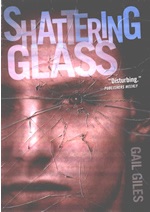
Shattering Glass

Module 8, SLIS 5420

Summary

Simon Glass is a nerdy, overweight guy and is picked on by some of the elite students at school, especially former king of the hill Lance. Rob has replaced Lance at the top of the male pecking order and decides to use Simon as a tool to humiliate Lance. Rob, a mysterious and charasmatic transfer student, enlists his friends, including Young, the narrator, to turn Simon Glass into a popular guy. He succeeds in changing Glass into a new person, accepted by almost the entire school, but have Rob and the gang underestimated the apparently timid and pliable Glass? What are the consequences for everyone involved?

Bibliographic Information

Giles, Gail. Shattering Glass. Simon Pulse, 2002. ISBN: 0-7569-1480-9

My Thoughts

This is a very disturbing book. There are hints throughout it in the introductions to every chapter that something bad is going to happen. The consequences for those involved are hinted at, as are the identities of those who are held responsible for what happens, but the facts are played out in the order in which they occur and the reader is teased into following along to the end to find out what actually happens. This is a very effective tactic on the part of the author. All of the characters are depicted as having very human qualities. No one person is entirely good and no one person is entirely bad. Together, their qualities and frailties help to contribute to a plausible and unfortunate ending. The reader is left to think about how the best laid plans can get out of hand, how difficult it is to anticipate the results of one's actions, and how those actions can affect one (and others) for the rest of their lives.

Reviews

Gr 9 Up-Gail Giles' debut young adult novel (Millbrook, 2002) makes a searing audio production as read by Scott Brick. His cold, calculating delivery style raises the tension on this already tense story about an in-group of high school seniors led by a true sociopath. Listeners can tell from an early scene involving torture of a laboratory animal that Rob means the most chilling sort of trouble for Simon Glass, class misfit. The story's narrator, Young Steward, a member of the clique, makes clear the grip Rob has on all his friends and focuses on his implacable intention to re-make Simon for purposes of his own. The violent frenzy Rob orchestrates ends in Simon's death after he shows signs of self-confidence that Rob can't allow. With a constant edge in his voice, Brick never lets up as he relates this riveting story. One somewhat problematic factor is the series of quotes from classmates and adults that introduce each chapter. As read, they are sometimes difficult to distinguish from the actual chapter narrative, leading to momentary confusion. The cover includes a list of chapters contained on each side of the tapes, a nice feature for finding a place in the text version. Reminiscent of Lord of the Flies, this is a story with mature themes focusing on the darkest side of human nature but in the most chillingly realistic of modern settings. The compelling writing is enhanced with convincing narration, but its intensity may give pause for thought.
Fenn, Jane P. School Library Journal. July 1, 2003.

By the end of the first paragraph, readers know that Simon Glass was easy to hate and that eventually he was killed. It takes the rest of the book to find out who killed him and why. Told in the different voices of students, teachers, counselors, and law-enforcement officers, the story unfolds little by little until the explosive climax. The reader soon realizes that the narrator of the story, Young, was one of Simon's classmates and is in prison for killing him, but it does not seem possible given the manner in which Young's character is portrayed. It soon becomes clear that Rob, Young's friend and unofficial group leader, is a master manipulator, pulling the strings of all the characters, influencing their actions to fulfill his master plan. In the early pages of the book, the language used by the students, the way they talk to and refer to each other might not seem authentic. After that initial reaction, though, as the suspense begins to build, readers will find it hard to put down the book. Robert Cormier's recent The Rag and Bone Shop (Delacorte Press, 2001/VOYA October 2001) explores the question of how a person can be influenced to do something that they ordinarily would not do. Although the plots of the two books are dissimilar, Giles's novel is also a chilling portrayal of manipulation leading to tragic consequences. Teens in upper middle school and high school will relate to the characters and, sadly, to some of the events in this book.
Roberts, Linda. Voice of Youth Advocates. June 1, 2002.

Awards

California Young Reader Medal

Suggestions for Use in Library

This would be a good candidate for helping students understand the dynamics of student popularity and the dangers of blindly following the advice or suggestions of fellow students. The story could be used to help students try to identify the motives of others and trace the consequences of not following one's own instincts.

Ace Lacewing, Bug Detective

Module 8, SLIS 5420

Summary
Ace Lacewing is a private investigator in the City of Motham. Mayor Buzzbee asks him to investigate the disappearance of Queenie Bee, a major town celebrity who endorses the products of the Hive Rise Honey Company. Ace follows a suspicious trail of warm honey from the scene of her apparent kidnapping to the factory of a honey-producing rival. What is going on here? Can Ace and his friends Dr. Xerces Blue and Sergeant Zito the mosquito solve the mystery and save Queenie?
Bibliographic Information
Biedrzycki, David. Ace Lacewing, Bug Detective. Charlesbridge, 2005. ISBN: 1-57091-569-5
My Thoughts
This picture book is beautifully illustrated, done in pencil and then colored using Photoshop. There is remarkable detail and little nuggets of humorous information imbedded in the art, such as through neon signs in the background and newspaper articles in the foreground. The latter might be seen in newspaper dispensing machines or in the hands of insect readers. Ace is the kind of detective who charges into danger without thinking about the consequences and Xerces has to save him from his enthusiasm. This is a nice introduction to mysteries for a younger reader. Along the way, the reader might also learn something about different types of insects.
Reviews

Gr. 2-4, younger for reading aloud. When Queenie Bee, of Hive Rise Honey, goes missing, Motham City is abuzz. Tough P.I. Ace Lacewing (Bad bugs are my business ) is on the case. Red herrings (mosquitoes, maggots, and walkingsticks in this case) abound, all with different stories, but the trench-coat-and--fedora-clad detective remains undaunted, sleuthing his way through the clues until a sticky surprise revelation. Biedrzycki ( The Beetle Alphabet Book, 2003) makes his debut as an author here, and although his story is sometimes text heavy, it's filled with snappy dialogue, wordplay, and puns that will especially appeal to kids with some knowledge of insects (words such as pupae are used). The slick, computer-assisted art has a cartoon flair; and its shadowy backgrounds have a noir flavor. Biedrzycki uses occasional pops of primary color and an array of perspectives and witty detail to add interest. Entertaining fare for those who appreciate creepy crawlies on the humorous side, this will attract both good readers and fans of seek-and-find books.
Rosenfeld, Shelle. Booklist. September 1, 2005.

Gr 1-4-Motham City is abuzz with the kidnapping of Queenie Bee, and Ace Lacewing, the Sam Spade of insects, is on the case. His motto is, "Bad bugs are my business." Lacewing follows the trail of honey with the help of his gal, Doctor Xerces Blue, and Sergeant Zito, a mosquito. A motley (and sometimes molting) assortment of suspects is questioned. Their character traits are based on facts: "The roaches said of course they ran from the scene of the crime-it was their nature to scatter when the lights go on." Puns and wordplay abound: "I've known him ever since we were pupae at the same school"; "The full moon hung in the sky like a large compound eye...." The digitally enhanced illustrations evoke a film noir atmosphere, with moody blue and black backgrounds. The pages are also brimming with humorous details such as glowworm street lamps, "Bug Off" police tape, and "Slow Larvae" road signs. This clever parody of hard-boiled detective stories is sure to tickle readers' thorax.
Ludke, Linda. School Library Journal. August 1, 2005.

Awards

North Carolina Children's Book Award (Nominated)

Suggestions for Use in Library

A teacher or librarian may use this book to work with children on identifying different types of insects, as there are many species used in the illustrations. Another use might be to identify different activities that various bugs are engaged in.

Friday, July 23, 2010

What If You Met a Pirate?

Module 7, SLIS 5420

Summary

Author/Illustrator Jan Adkins begins this book by comparing the image one is likely to have gained of the average pirate through movies or novels with that of the average pirate as seen through historical fact. He uses humorous language and imagery to help convey these differences. He then goes on to provide information about pirate ships, weaponry, and tactics in fighting (or avoiding!) battles in their quest for booty. He also provides information about the kinds of loot pirates were likely to find, how they might sell it, and how they spent their money. The life of a pirate was not like the glamorous image that Hollywood tries to sell to us in movies, and this comes across in the book. The reader will learn a great deal about actual pirates and the history of piracy, from the days of the Greeks until present times.

Bibliographic Information

Adkins, Jan. What If You Met a Pirate? Roaring Book Press, 2004. ISBN: 1-59643-007-9

My Thoughts

The subject of pirates is a very interesting one, especially to young boys. Who hasn't dreamed of finding pirate treasure? The author does a very good job of getting a great deal of factual information and history into a small package with this book. The illustrations are quirky and do not pull any punches. In talking about the horrific wounds and their causes, Adkins accompanies the text with illustrations that include scars, lost limbs, and ill-healed wounds. He also depicts the ships and weapons used by pirates and discusses their preferred tactics. He is also careful to point out historical inaccuracies that have crept into pirate lore over the years, such as the idea of "walking the plank." He also points out that pirates were a democratic existence, voting for captains or voting them out if they failed to please a crew. This is a good overview of what led men to turn to a life of piracy, and what life would be like for them.

Reviews

Starred Review. PreS-Gr 4Adkins begins with a stereotypical picture and description of a pirate, then proceeds to debunk the myths that surround these mysterious figures. Contrary to popular belief, pirates did not command large ships with guns and cannons, but preferred smaller, more nimble vessels so they could take victims by surprise and make a quick escape. Real pirates were as skillful with a needle as they were with a cutlass; most sewed their own clothes and mended sails. Packed with interesting but little-known facts, the text illuminates life on the high seas and answers many questions children may have: Did pirates force captives to walk the plank (no) or bury treasure (rarely)? Do pirates still operate today? Each of these questions and more are answered in spreads that include full-color spot illustrations, diagrams, and cross-sections. Adkins's detailed renderings will be as familiar to fans of his other nonfiction books as his tongue-in-cheek humor, both of which appeal to a broad range of ages. A fun and informative read.
Edwards, Laurie. School Library Journal. Date not given.

Gr. 3-5. Can it be that walking the plank was a fictional punishment invented by illustrator Howard Pyle? In this appealing book, Adkins gives readers the lowdown on what life under the pirate flag was really like. After setting up the conventional portrait of swaggering, singing sailors in colorful duds, he replaces it with a more realistic picture of hard-working sailors who might swashbuckle just a few hours each month and bathed considerably less. Yet this realistic portrayal of pirates and their activities is even more intriguing than the romanticized version he debunks. Adkins strikes just the right note in the text, always informative and frequently entertaining as well. Bright with color washes, the excellent, energetic drawings show pirates engaged in a variety of activities, from pumping out the bilge to braiding each other's hair to using the open-air bathroom at the front of the ship. In a send-up of current book marketing, the back cover carries appreciative comments by the likes of Queen Elizabeth I and Leonardo da Vinci. Where pirate fever runs high this spirited presentation will find an enthusiastic audience. For more titles, see the Read-alikes, Ship Ahoy!
Phelan, Carolyn. Booklist. October 15, 2004.

Awards

Utah Children's Informational Book Award

Suggestions for Use in Library

Children could be asked what they know or think they know about pirates. Then the teacher or librarian could work through the book to try to confirm or deny the gathered impressions.